Week 2 - First end-to-end GWPCA implementation and notebook demo
This was the week where the project started feeling real.
Up to this point, I had mostly been understanding the package and preparing for the implementation. In Week 2, I finally pushed the first full end-to-end GWPCA path into shape around PR #125. The estimator could fit, expose outputs, and be exercised on a real dataset instead of only being an idea or a rough prototype.
Commits This Week
6678649-sample-gwpca
What I Worked On
The main work this week was getting the first usable geographically weighted decomposition implementation into the branch:
- writing the initial
GWPCAestimator logic - fitting a local PCA at every focal location using geographically weighted neighborhoods
- exposing local loadings, scores, and local explained variance outputs
- adding decomposition-focused tests so the implementation was not just notebook-driven
- building a demo notebook to see whether the method actually made sense on real spatial data
The notebook mattered more than I expected. Unit tests can tell you whether code is coherent, but they do not automatically tell you whether the workflow is understandable. A method like GWPCA produces a lot of local structure, and I wanted to see whether the outputs were interpretable when used the way a user would actually use them.
Why the Notebook Was Important
I used the Guerry dataset because it gave a concrete, spatially structured example where localized principal components are meaningful. The notebook let me compare:
- a single global PCA summary
- the geographically weighted version
- how the first local component changed from place to place
- how the contribution of variables like
Wealthshifted spatially
That workflow exposed something useful very early: even before all the API and testing polish, the method already showed clear spatial variation in the dominant component structure. That was encouraging, because it suggested the implementation was producing something substantively meaningful and not just mechanically correct output.
Notebook Snapshot
The core workflow looked like this:
variables = ["Crm_prs", "Litercy", "Wealth", "Donatns", "Infants"]
X_scaled = pd.DataFrame(StandardScaler().fit_transform(X), columns=variables)

gwpca = GWPCA(n_components=2, bandwidth=25, fixed=False, kernel="bisquare")
local_scores = gwpca.fit_transform(X=X_scaled, geometry=gdf.centroid)
And before switching to the local decomposition, I also printed a global PCA baseline:
Global PCA Explained Variance Ratio:
[0.35715985 0.22827994]
That baseline was useful because GWPCA is much easier to explain when you first anchor the discussion in a familiar global PCA result and then show what changes once locality is introduced.
Notebook Figures
The notebook also produced the following maps:
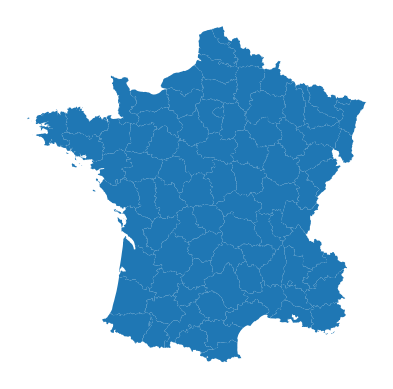
Base geometry from the Guerry dataset before running the localized decomposition.
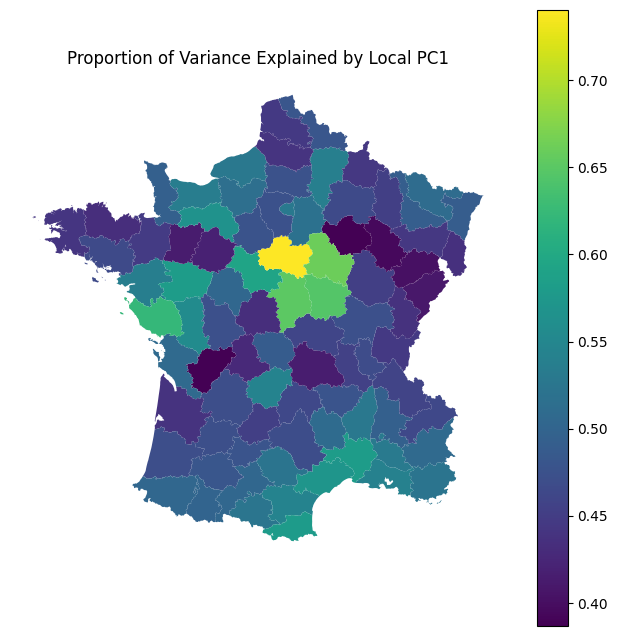
Spatial variation in the proportion of variance explained by the first local principal component.
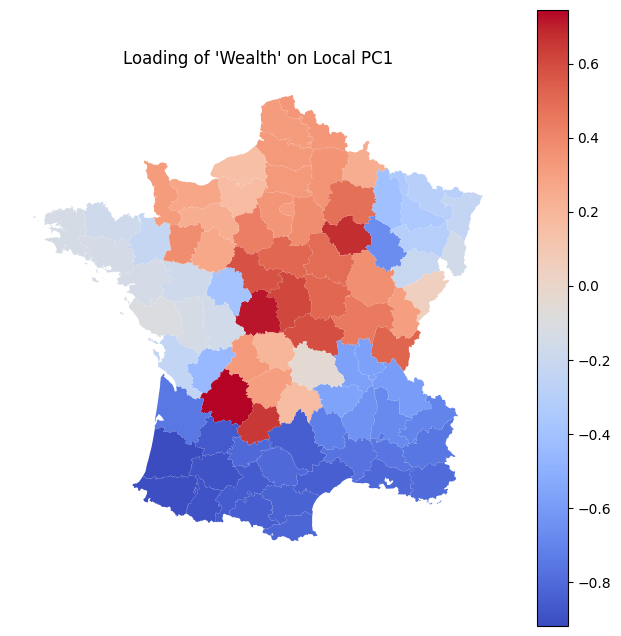
How the loading of Wealth on the first local component changes across space.
Seeing those figures helped me think about the implementation from a user perspective. It is one thing to return arrays. It is another thing to return outputs that people can immediately map, compare, and reason about.
What Felt Hard This Week
The difficult part was that I was still balancing two jobs at the same time:
- inventing the decomposition logic
- trying to make it fit a package structure I was still learning
That meant some early code naturally leaned a little “prototype-ish.” It could run, but some of the design questions were still open:
- How should decomposition fit into the broader estimator hierarchy?
- How should local outputs be labeled?
- How much should it reuse existing bandwidth-search machinery?
- Which parts should remain decomposition-specific, and which parts should become generic?
Those questions did not all need to be answered in Week 2, but the first implementation created the surface where those answers would later matter.
Main Outcome
By the end of the week, I had something much more important than a commit title: I had the first version of GWPCA that could be fit, tested, and demonstrated. It was still early and definitely not “review-finished,” but it gave the project a working center of gravity.
That mattered because all the later work - covariance alignment, R comparison, API cleanup, pandas outputs, edge-case handling, and review fixes - had to build on a concrete implementation. Week 2 created that base.